Product Design • Service Design • System Thinking
CARE, Vulnerable Observatory
Identify hidden financial vulnerability
Details
TYPE
Master’s Studio Project
TEAM
4 PSSD students
I conducted research, shaped service concepts
and designed the platform (app/web).
DURATION
4 months (Oct - Jan 2025)
Many young women experience forms of financial vulnerability, such as unpaid internships or low-paid work, without recognizing them as such.
The observatory builds a multi-source sensing network, transforming dispersed individual experiences into quantifiable data evidence.

Challenge
How might we close the gap that current social services are reactive and individual struggles remain fragmented? We aim to shift from managing individual crises to sensing systemic signals.
Solution

An accessible observatory around Milan through a participatory, bottom-up system.
The system connects community agents, physical micro-interventions, and a data collection platform.
We designed a mobile app and dashboard platform tailored to different user groups, enabling effective participation.
The project was developed in collaboration with ActionAid.
Process
Research (Primary, Secondary, Technology)

Research integrated primary, secondary, and technology analysis, followed by critique and fact-checking.
Co-design Sessions

Conducted 3 co-design sessions with experts, young women, and NEET women to refine the service.
Findings
Systemic issues keep users trapped in recurring patterns of vulnerability.
Response: Drive structural change with a scalable model that builds on existing resources.
Vulnerability is shaped by power dynamics in work and schools.
Response: Build a multi-sided ecosystem where every actor in the system shares responsibility.
Users need one trusted place for support and safe peer connection.
Response: Unify scattered resources into a single entry point with space for community.
How we conducted co-design sessions

Session 1: Expert Insights (ActionAid)
Aim: To define the observatory’s functional boundaries and core features.
Session 2: User Validation (Young Women)
Aim: To explore perspective of ‘observe’ and validate the effectiveness of proposed digital touchpoints.
Session 3: Field Research (NEET Women)
Aim: To identify specific vulnerabilities to build effective communication channels.
Service Flow

Architected the end-to-end service concept flow, ensuring a seamless integration of user needs and system requirements.
Persona

Defined 3 different personas based on the roles and needs.
Information Architecure

Mapped the information architecture to distinguish web and mobile functionalities based on user context and criteria.
Wireframe

Rapidly sketched low-fidelity wireframes and iterated platform structures to ensure a seamless connection.
Outcomes
An integrated digital platform within the CARE service ecosystem runs across three connected web and apps, one for each role in the service. Women reach out and share their situation, agents report from the field, and operators turn all of this into support decisions.


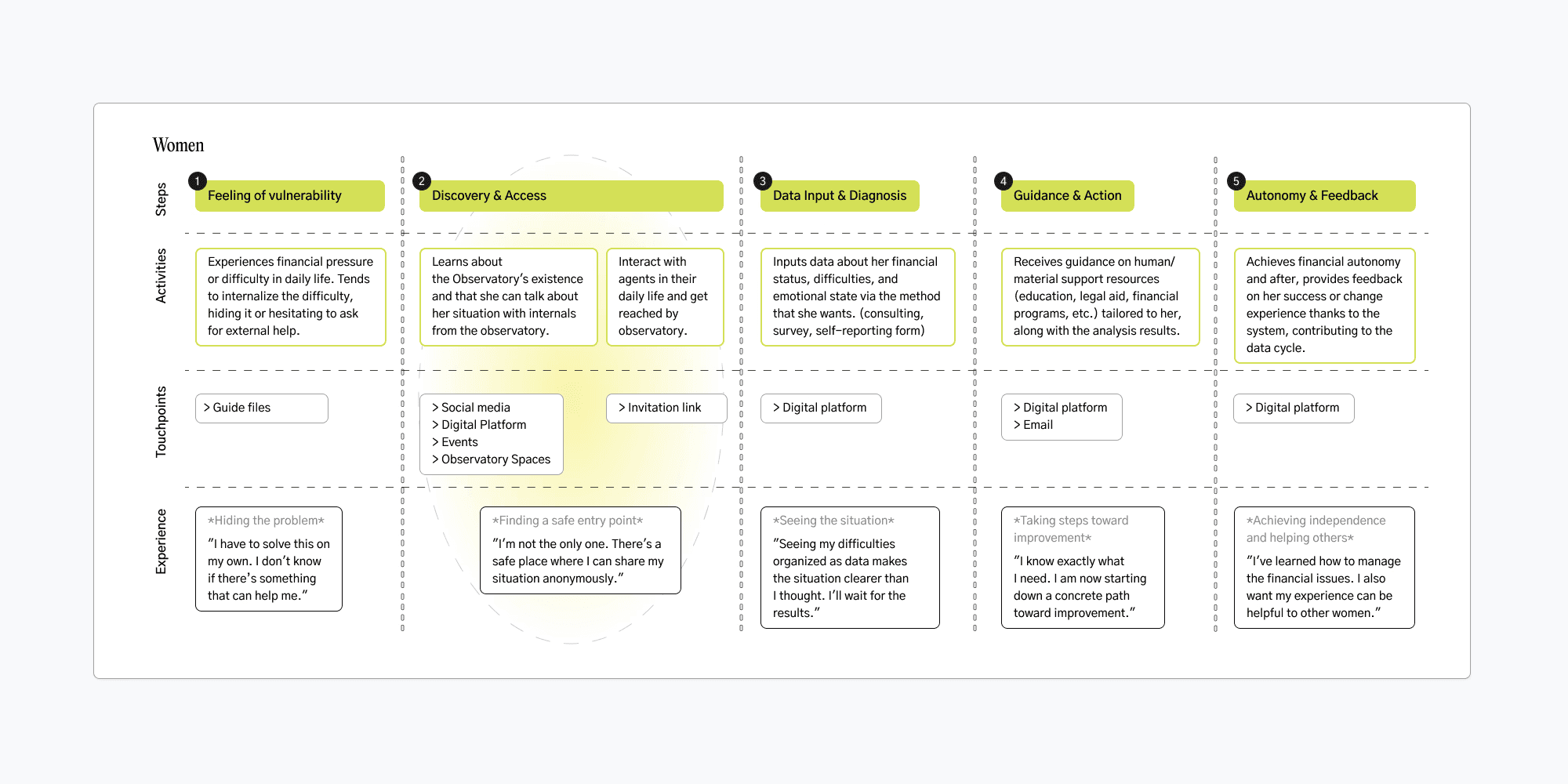
User Journey Mapping
Defined three core user profiles, Operators, Women, and Agents, and designed journey maps to identify critical touchpoints and pain points.


Design System
Created a visual identity and component-based design system that ensured consistency and scalability across the platform.

Final Design
Operators' Data Dashboard
A workspace where operators turn raw case data into support decisions, followsing three stages. The main design challenge was making AI-generated insights legible and trustworthy, while keeping the final judgment clearly in the operator's hands.

1. Data Input
Operators gather the facts before any judgment begins. No analysis here, only what is already known.
2. AI Analysis
The AI surfaces patterns and suggests next steps, each marked with a confidence signal and its source.
3. Review
Operators accept, edit, or reject every AI item, then sign off. The final judgment stays with the human.
AI overlay

Loading with intent
Introduces a deliberate delay to clearly signal AI-driven processing. Showing each step of the analysis reminds operators to critically review and validate the results before final approval.
Product Thinking

Problem: The source panel took 30% of the screen, repeating input-step data.
Decision: Collapsed to one line that expands only when an operator verifies.
Why: Source is reference metadata, so its weight should match its importance.

Problem: Source under each card pushed the cards to different heights and broke the grid.
Decision: Source opens in place on click, without resizing the card.
Why: AI risk patterns can't be truncated, and the grid has to stay readable.

Problem: One highlight colour covered the whole AI text, so edits were invisible.
Decision: Grey for the AI draft, lime only on words the operator changed.
Why: The record must show what the AI wrote versus what the human changed.
Women's app
A self-guided space where women assess their own situation, book consultations, and receive their final report. The design focuses on lowering the barrier to reach out, letting women share sensitive information at their own pace through various methods (self-assessment, surveys, and scheduled support).

Agent's app
A mobile tool for community agents working in the field. Agents complete their training, activate their account, and submit reports on the women they meet. The design keeps data entry simple on mobile, so agents can capture what they observe on the spot and pass structured cases to operators.

Use of technology
Addressed digital divide and data privacy as a central. Through targeted case studies, we developed an ethical framework for AI and data usage, prioritizing transparency and protection as core service values.
Ethical AI Cavas

Business Context
Mapped where CARE sits against existing players, and traced how the service turns resources into long-term impact.
Positioning
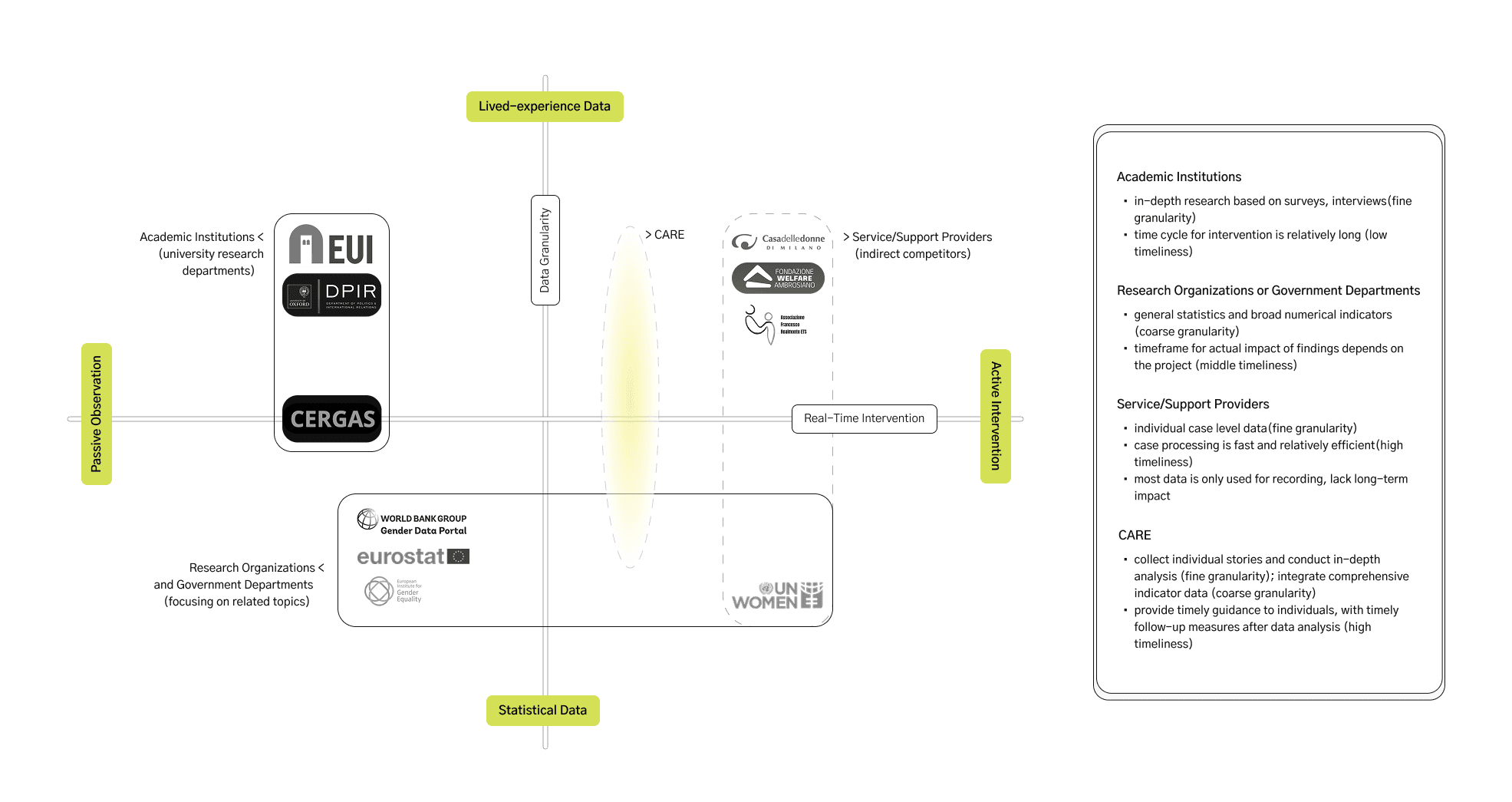
Academic research holds deep data but acts slowly. Service providers act fast but only record. CARE does both, turning stories and statistics into timely intervention.
Impact Canvas

Funding and trained agents feed a vulnerability dashboard. Earlier detection follows, then stronger financial autonomy for women, looping back into the service.
Presentation
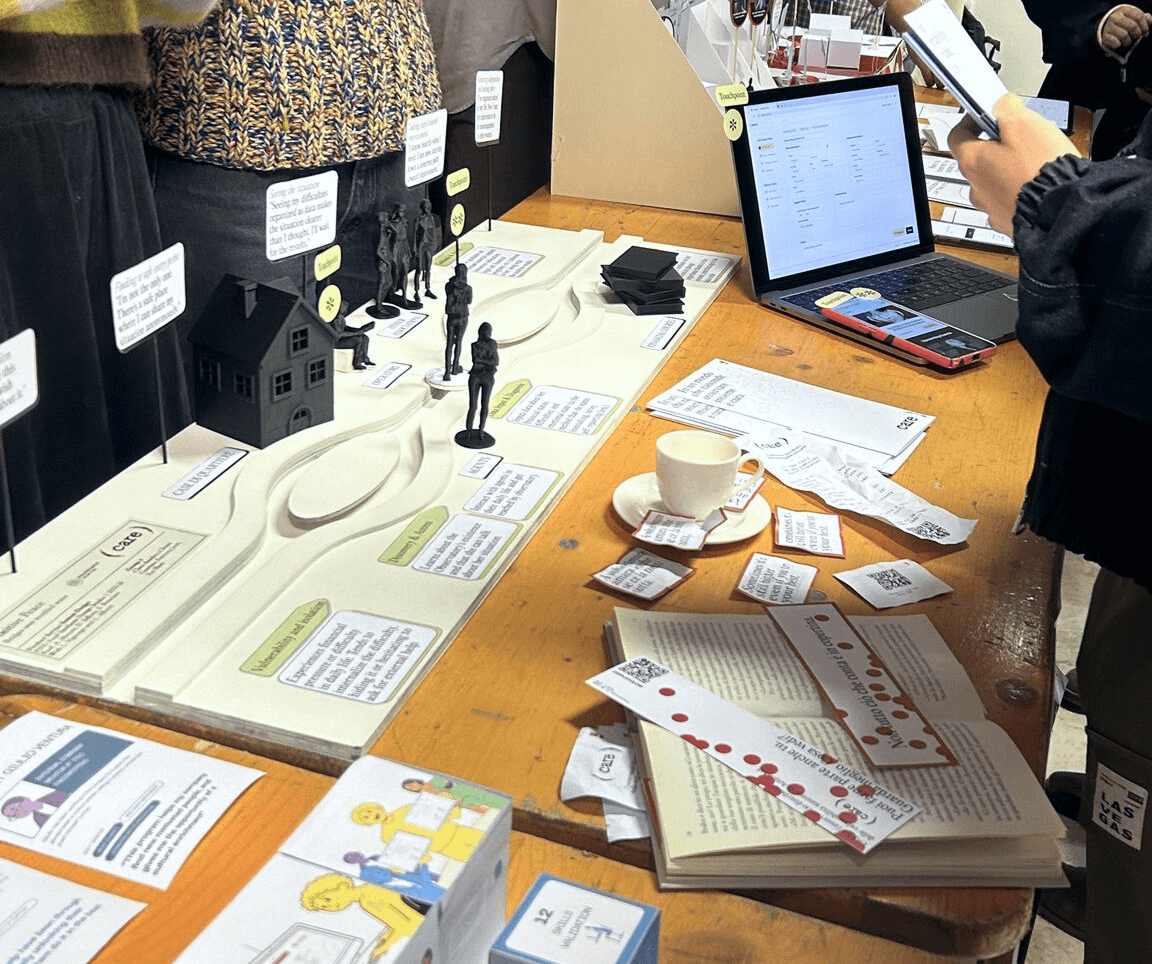
Showcased CARE at the Italian Red Cross, presenting a systemic service design solution aimed at visualizing and addressing the unrecognized financial precariousness of women.

More Projects

