Research • Service Development • Business Strategy
Naver Cloud Passkey
Strategic Planning for a B2B Face Recognition Solution
Details
TYPE
Internship at Saas Cloud Company
TEAM
1 Lead, 2 Sr. PMs, 2 Jr. PMs
DURATION
3 months (Sep - Dec 2023)
NAVER Cloud developed FaceSign, a facial recognition system, but the technology lacked productization. At the same time, the market was moving toward passkey-based authentication (FIDO2).
I conducted research and service planning to bridge this gap, defining the product vision, mapping use cases, and creating a framework.

Challenge
How might we transform FaceSign into a scalable and business-oriented B2B authentication solution that remains user-friendly and secure, aligned with passkey trends?
Solution
We positioned FaceSign as a scalable passkey service that delivers a seamless passwordless experience, integrating core technologies such as FIDO2 and the Naver Cloud ecosystem. By framing the solution as a SaaS model, it not only enabled frictionless authentication for users but also opened new opportunities for B2B adoption.

My Role

Tech and market research on passkey service/face recognition
Competitor benchmarking (7+ players)
Strategic 6-pager and PR/FAQ documentation
User scenarios and platform planning
Research
Competitive Analysis
Global tech leaders such as Apple, Google, and Microsoft
transitioned to passwordless authentication through passkeys
using their own facial recognition technology

Other companies such as Adobe, PayPal, GitHub, and Amazon
support passkey login through Apple or Google’s biometric systems
but do not operate their own biometric infrastructure

State of the Business
Despite the global rise of passkeys, few platforms control the full stack of biometric technology and cloud infrastructure required for robust B2B services. Naver Cloud is uniquely positioned as the sole domestic provider possessing this integrated trifecta.

Key business insight:
By owning the end-to-end authentication ecosystem, Naver Cloud can significantly reduce B2B integration costs and complexity by eliminating the need for third-party biometric infrastructure.
Experience
Platform-Level Scenarios
Scenario1: OAuth Extension
Adding biometric authentication to existing Naver Login services with minimal integration.

Scenario 2: SDK Integration
Provide a fully branded FaceSign-Passkey service via dedicated SDK and admin tools.

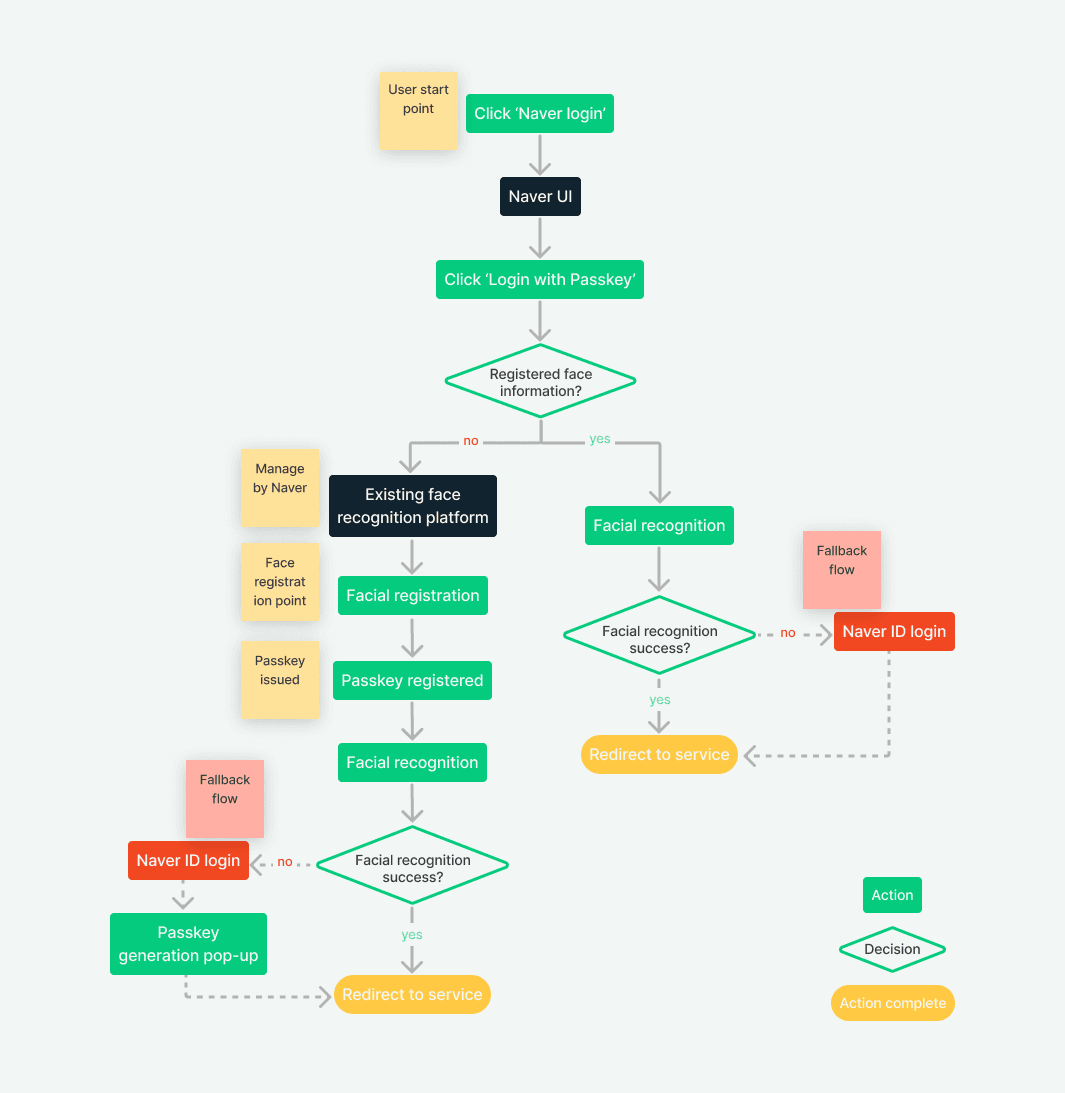
User Flow
Mapped out user flows considering key interaction points: from initial entry and face enrollment to fallback logic and passkey generation.

Impact
Informed internal roadmap decisions through a strategic planning deck
Cited in 3 cross-functional leadership reviews as a reference for future directions
Shifted perspective: FaceSign seen as a service opportunity

Reflection
This project taught me how to connect business strategy, system design, UX, and service in a real enterprise context. I learned to turn technology outputs into user-centric experiences while aligning with infrastructure constraints like FIDO2 and Naver Cloud, and to bridge silos between AI, hardware, and platform teams.
Next time, I would further develop Admin Tool wireframes with prototyping and usability testing to better validate internal workflows.
More Projects

